Accelerating Semiconductor Design: AI Surrogate Modeling with PINO using NVIDIA PhysicsNeMo Framework
16 Dec 2025
This project is ongoing, so stay tuned for updates!
Check out our Preprint: ArXiv Link: https://arxiv.org/abs/2603.06881
Motivation: The Z-Scaling Bottleneck
As we push the boundaries of 3D FeNAND technology, continued Z-scaling is becoming increasingly limited by Lateral Charge Migration (LCM) and the complex interplay between polarization and trap charges. To optimize these devices, we need to explore a massive design space—sweeping geometries, pitches, and temperatures.
However, conventional Technology Computer-Aided Design (TCAD) simulations are a major bottleneck. A single simulation condition can take roughly 1 day to complete. This computational cost makes large-scale design space exploration prohibitive. To solve this, we have developed an AI Surrogate Model on NVIDIA PhysicsNeMo framework using Physics-Informed Neural Operators (PINO) to drastically accelerate the design process.
TCAD vs. AI Surrogate: A Paradigm Shift
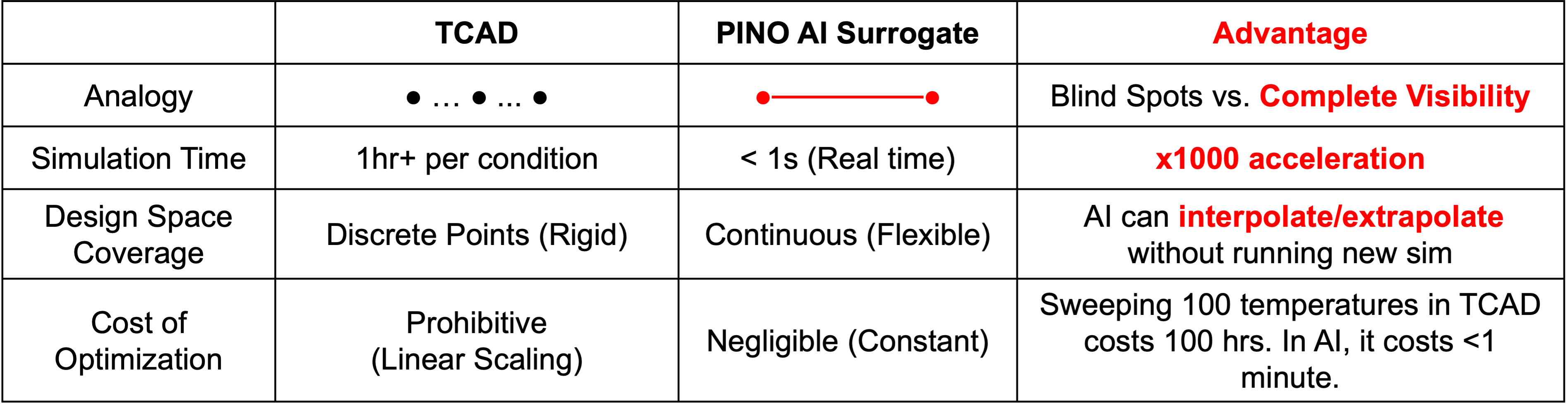
The difference in performance is stark. While TCAD provides discrete data points at a high cost (linear scaling with the number of experiments), the AI surrogate model offers a continuous, flexible design space with negligible inference cost.
- Simulation Time: >1 hour per condition (TCAD) vs. <1 second (AI).
- Acceleration: Approximately x1000 speedup.
Methodology: Physics-Informed Neural Operator (PINO)
Our model is not a “black box.” It is a Physics-Informed Neural Operator (PINO) that learns the mapping from input conditions to physical solutions based on governing physics laws (Poisson, Gauss, Arrhenius, etc.).
Architecture
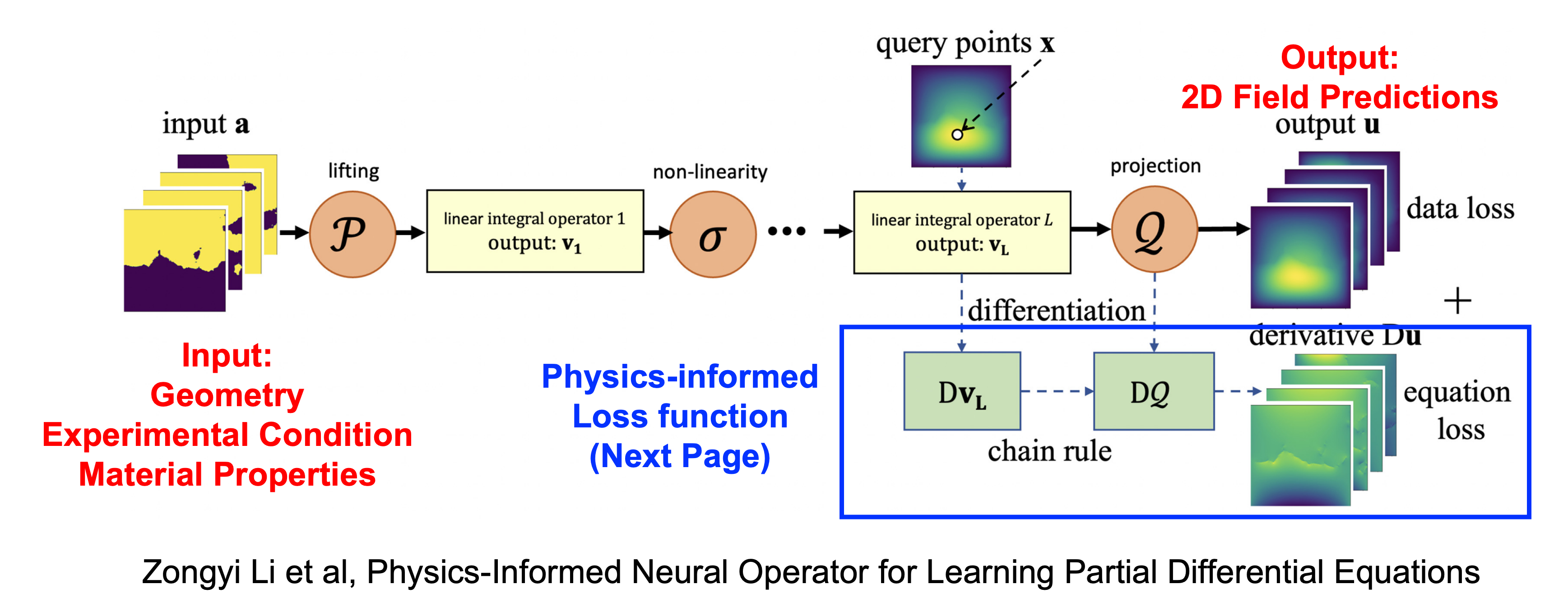
The model takes specific experimental conditions as input and predicts full 2D physics fields as output:
- Input: Geometry (HZO thickness, Z-pitch), Temperature, Retention Time, and Ferroelectric material properties.
- Output: 2D Field Predictions (Potential, Current Density, Trapped Charge).
Hybrid Loss Function
To ensure physical validity even with sparse training data, we utilize a “Hybrid” modeling approach that minimizes two errors simultaneously:
- Data Mismatch: Matching the TCAD ground truth (Data Accuracy).
- Physical Violation: Enforcing consistency with Poisson’s Equation (\(\nabla^2 \phi = -\rho/\varepsilon\)), Gauss’s Law, and Arrhenius relationships.
This physics-informed loss is crucial for predicting long-term retention behaviors where purely data-driven models might produce “glitchy” or physically impossible charge migration patterns.
Proof of Concept & Results
We validated the framework on two distinct device architectures: a standard Si Channel Single FeNAND and a more complex AOS Channel String Array.
1. Silicon Channel Single FeNAND
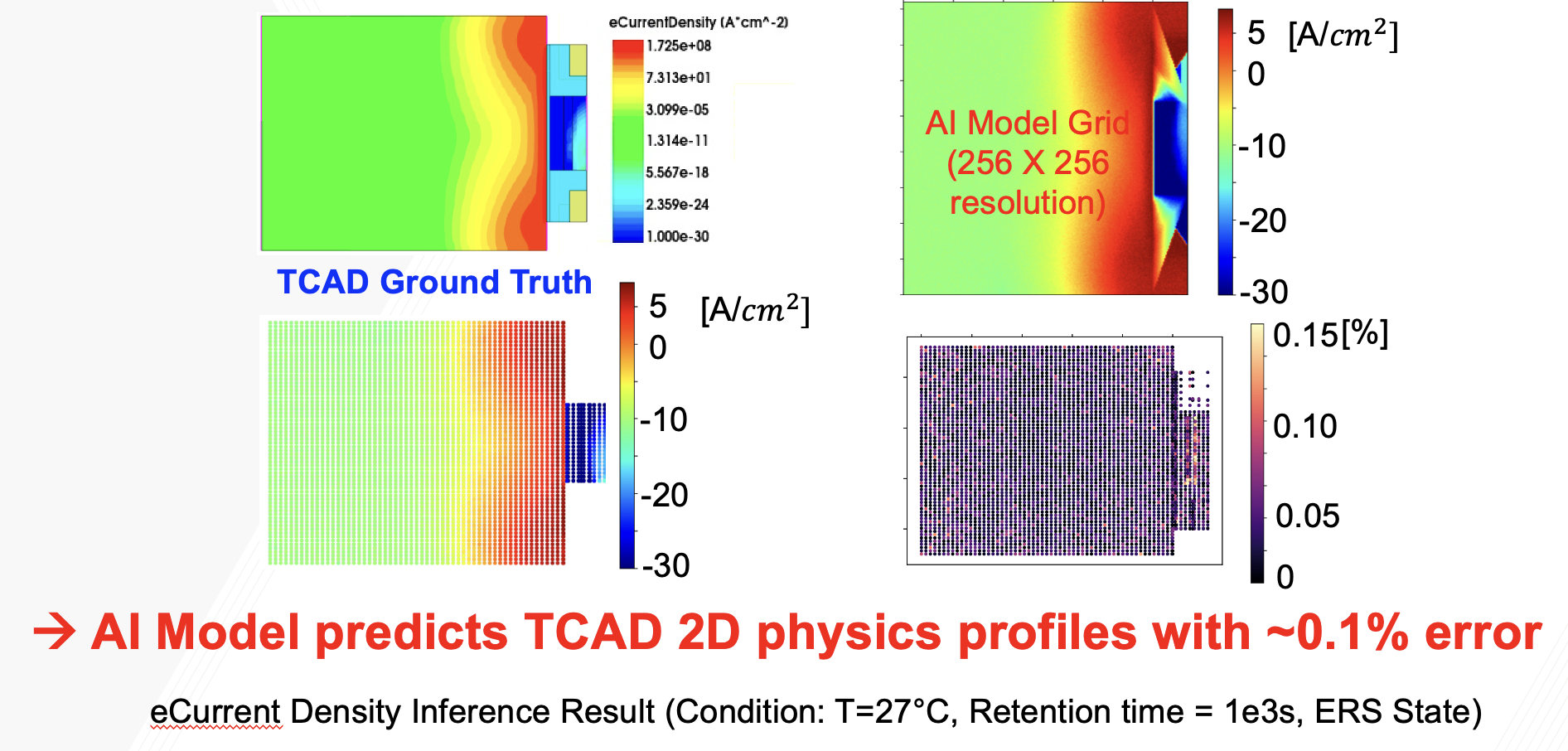
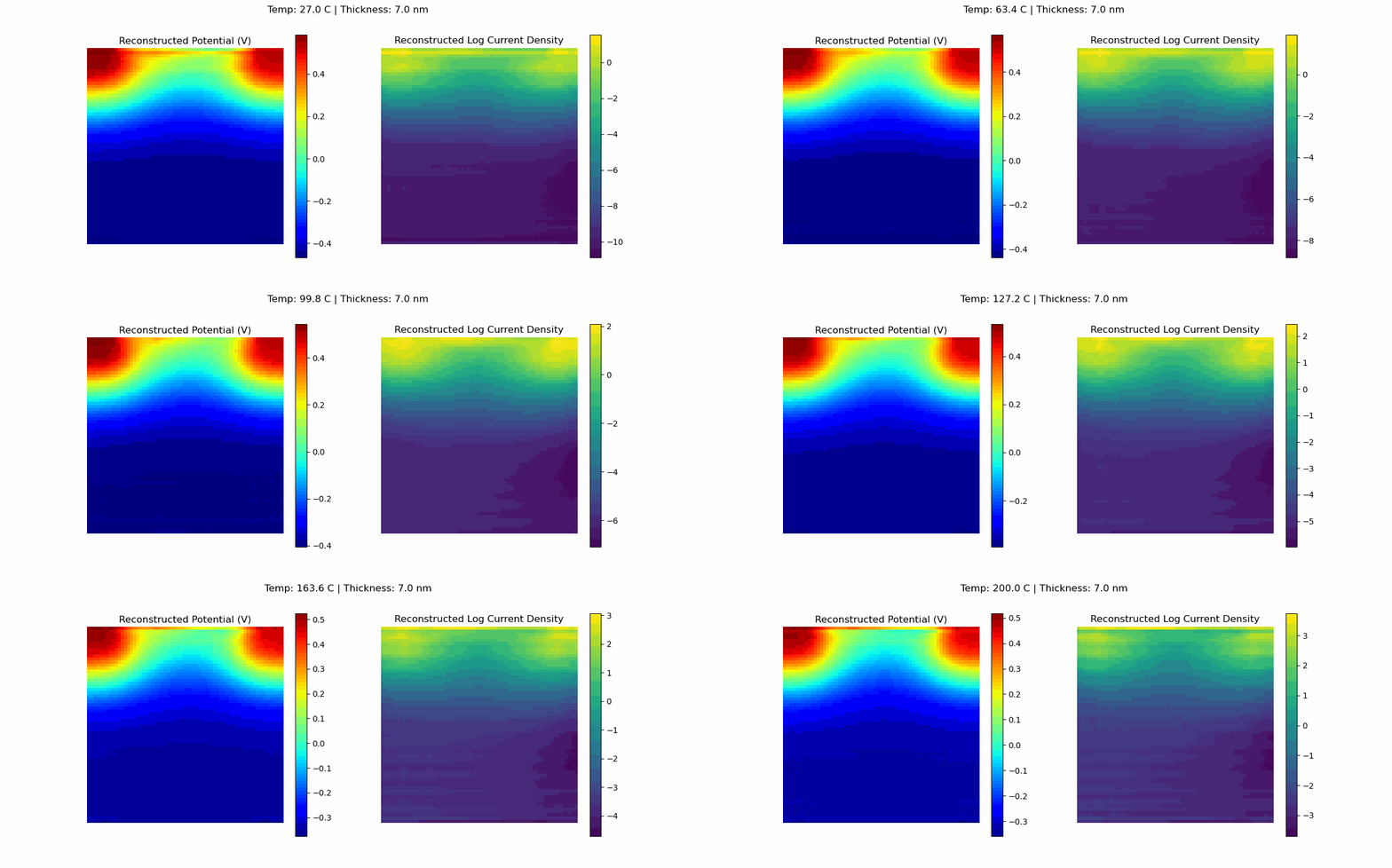
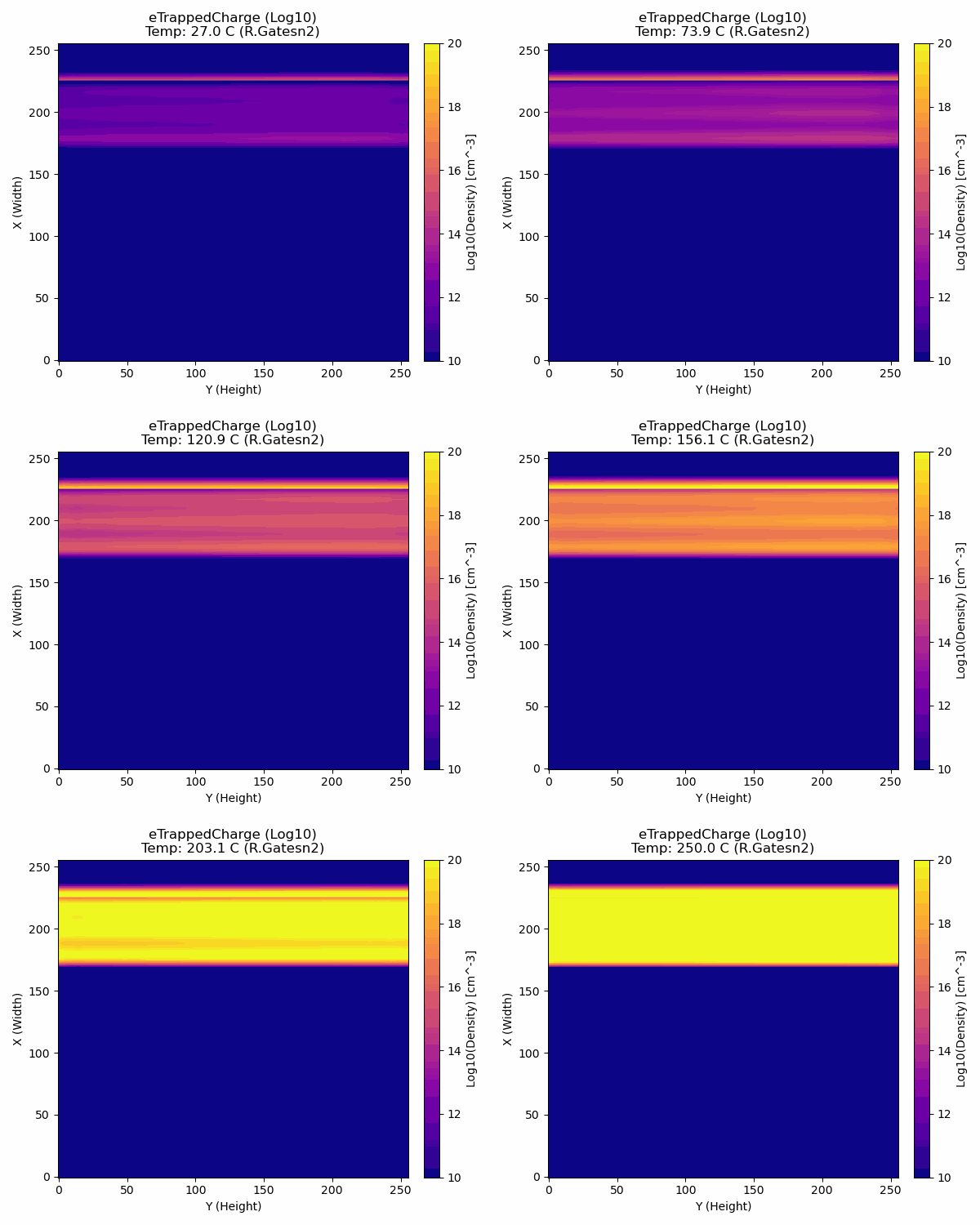 The AI model successfully predicts 2D physics profiles with remarkable accuracy. For example, when inferring eCurrent Density at 27°C, the model matches the TCAD ground truth with approximately ~0.1% error. It also faithfully captures the monotonic accumulation of trapped charge over time, governed by our physics loss.
Design Space Exploration (Interpolation): 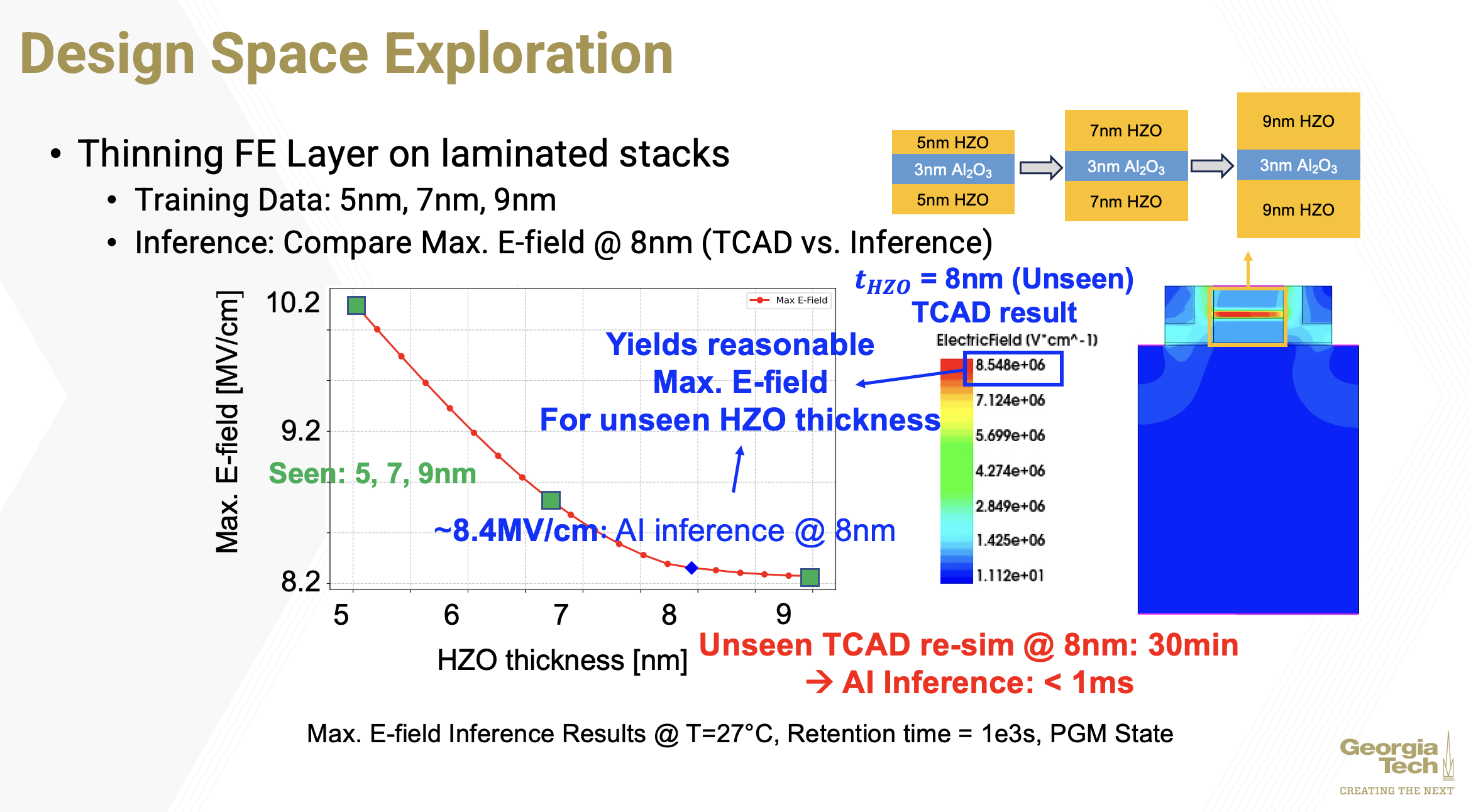
One of the most powerful features is the ability to infer results for “unseen” geometries.
- Training Data: 5nm, 7nm, 9nm HZO thickness.
- Inference: We queried the model for 8nm (a thickness it had never seen).
- Result: The AI predicted a Max E-field of ~8.4 MV/cm, which matched the ground truth verification almost perfectly.
- Time Saved: The verification simulation took 30 minutes in TCAD; the AI inference took < 1ms.
2. AOS Channel String Array FeNAND
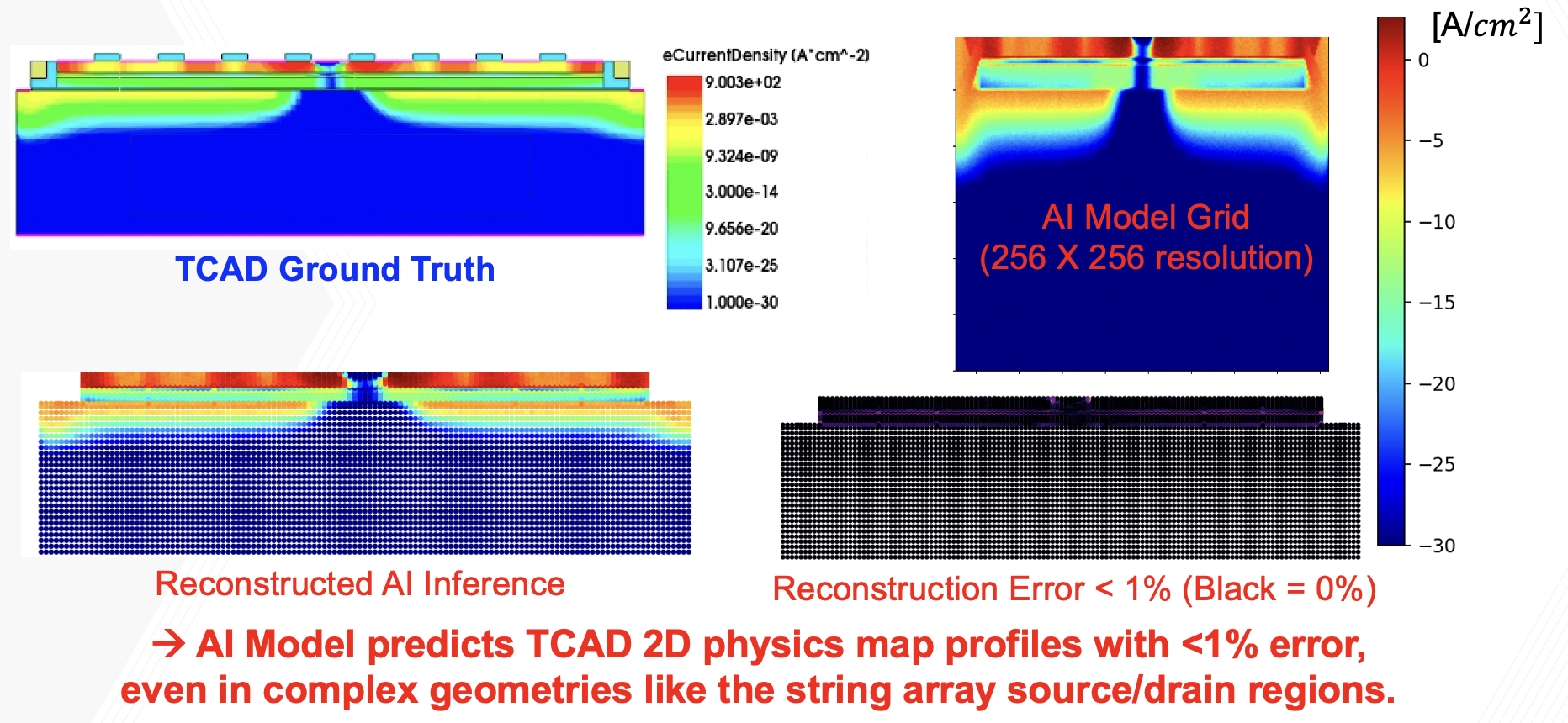
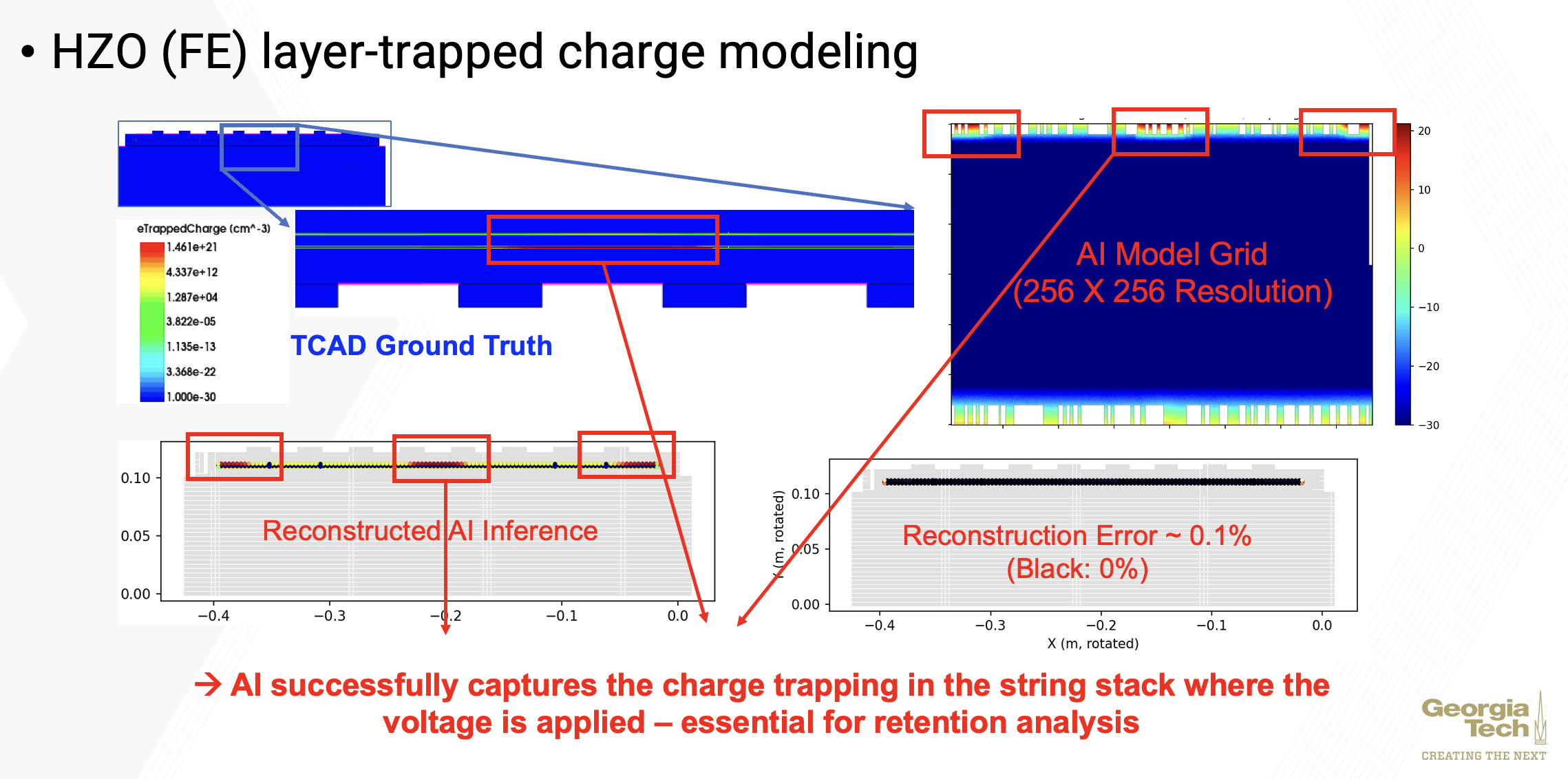
We extended the framework to a complex string array geometry with Oxide (AOS) channels. Even with the complex Source/Gate/Drain regions, the AI reconstructed the 2D current density maps with <1% reconstruction error. This proves the model can handle complex boundaries and material interfaces essential for realistic array-level modeling.
Summary and Future Work
We have developed an AI Surrogate Modeling framework that “faithfully accelerates” design space exploration for 3D FeNAND.
- Efficiency: Reliable inference with very sparse training data (as few as 3 sets per parameter).
- Speed: Real-time inference enabling massive sweeps.
- Physics: Governed by fundamental laws (Poisson, Gauss, Arrhenius).